By Ike Abonyi
In 2023, critics claimed that he was merely one of two or three people posting on Twitter from a room. Following his electoral showing, they now portray him as a youth phenomenon fueled by social media but lacking organisational structure. Yet Peter Obi’s political influence appears to be extending beyond Nigeria’s domestic political arena and attracting growing international attention. After receiving a strong domestic endorsement in Kano from his running mate, who repeatedly characterised him as incorruptible, Obi secured international recognition within 48 hours in Washington, D.C., where his leadership qualities drew considerable praise.
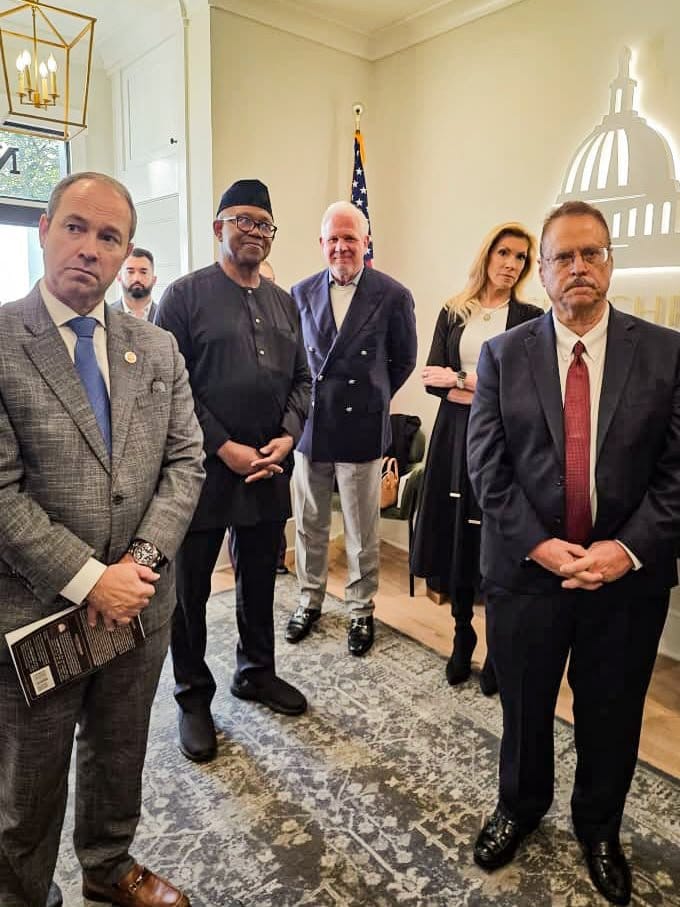
On Monday, 16 November, several members of the US Congress commended him. Those congressional figures included Representatives Marlin Stutzman, Todd Tiahrt and Beth Van Duyne, Suzanne Bock Grisham, and retired Colonel Albert V. Short.
At a reception, Stutzman called Obi a “true leader,” noting that the former Anambra governor placed the public interest above personal considerations and gave priority to education, healthcare, welfare, infrastructure and fiscal management. In a separate video from the same event, Tiahrt also praised Obi’s record in education, health, infrastructure, fiscal discipline and integrity.
The Washington, D.C., engagement commended Obi’s leadership and portrayed him as an exceptional figure whose selfless service as governor set him apart as an uncommon presence in public life. The Beyond the Border testimonial marks another important development in the expanding international recognition of the former Anambra State governor. The timing of these commendations is especially significant. They follow closely after his running mate, Rabiu Musa Kwankwaso, publicly characterised him as incorruptible, a quality that has become central to the political identity Obi presents and to the standards his supporters associate with his leadership. Although the endorsements are distinct, they support the same broader message: leadership should be judged not by the privileges gained in office, the political influence exercised or the wealth accumulated, but by the integrity, restraint, sacrifice and public benefit demonstrated in power. Obi’s tenure as governor remains his most compelling qualification. His eight-year administration in Anambra State continues to underpin his case for responsible leadership. His focus on careful resource management, investment in education and healthcare, institutional discipline and accountability sets his approach apart from a political culture in which public office is too frequently regarded as a means of personal enrichment. To his supporters, that record stands in marked contrast to the prevailing patterns of extravagant governance, public waste and political impunity. His political appeal, therefore, rests on more than campaign promises; it is grounded substantially in the claim that he has demonstrated some of the qualities he now presents to Nigeria. International recognition adds a further dimension to his political standing. For a politician whose domestic popularity has often been characterised by opponents as primarily youth-driven or limited to social media, acknowledgement from influential figures beyond Nigeria broadens the discussion. It indicates that his political message and record are drawing interest beyond the constituencies that have traditionally supported his popularity at home. Nevertheless, international commendations should not be confused with electoral victories. They do not automatically produce votes, nor do they resolve the demanding challenge of constructing a formidable national political coalition. Nevertheless, they enhance his credibility and provide his supporters with stronger grounds for asserting that the question of Obi’s leadership merits serious attention. The immediate task is to transform public esteem into political influence. Obi’s growing prominence, domestically and abroad, creates an opportunity while also placing greater obligations on him. Popularity must be translated into organisation, admiration into political mobilisation, and international recognition into support for the demanding effort to bridge Nigeria’s political, regional, religious, and social divisions.
Ultimately, Nigeria requires more than a president who is widely popular. It needs a leader whose character commands confidence, whose decisions reflect competence, and whose administration rebuilds public trust. The importance of the recent commendations in Washington, following Kwankwaso’s characterisation of Obi as incorruptible, lies in their reinforcement of a leadership narrative that is becoming increasingly impossible to dismiss. Peter Obi may have emerged initially as a domestic political phenomenon, but his leadership is now attracting growing international attention. The central question is whether Nigeria can convert that promise into the national transformation its people urgently need.
_Ike Abonyi is Editor@Large