Dangote Refinery reduces Petrol price to N1,200

Dangote Petroleum Refinery has reduced its ex-gantry petrol price to N1,200 per litre, marking a downward adjustment in its pricing structure.

The development was disclosed in a statement issued by the refinery on Thursday.

The price cut comes amid ongoing volatility in global oil markets driven by geopolitical tensions in the Middle East.

The latest adjustment represents a N75 reduction from the previous price of N1,275 per litre, despite rising crude oil prices globally.

The refinery also announced a reduction in its coastal price to N1,153, signalling potential downstream effects across Nigeria’s fuel distribution chain.

The refinery confirmed the price reduction and linked the decision to prevailing global oil market conditions. The move is expected to impact supply costs across depots and retail outlets.

“Dangote Petroleum Refinery & Petrochemicals has reduced its gantry price for petrol to N1,200 per litre and its coastal price to N1,153 per litre, a move that comes amid ongoing tensions in the Middle East that continue to influence global oil markets.”

“The adjustment marks a downward review in the refinery’s pricing structure and is expected to influence fuel supply costs across distribution channels, including depots and retail outlets.”

The statement underscores the refinery’s responsiveness to market dynamics despite global uncertainties. Newspot.

Tinubu expands PiCNG mandate to include electric vehicles 

President Bola Ahmed Tinubu has approved the expansion of the mandate of the Presidential Initiative on Compressed Natural Gas (PiCNG) in a new drive to reposition the initiative.
The initiative will now be known as the Presidential Initiative on Compressed Natural Gas and Electric Vehicles (PiCNG & EV).
With this approval, PiCNG & EV will lead and coordinate Nigeria’s clean mobility strategy, covering gas-driven vehicles and Electric Vehicles nationwide.
The Initiative will continue to drive the deployment of CNG infrastructure, including Mother and Daughter Stations, Integrated Refuelling Units, CNG vehicles and equipment, and nationwide conversion programmes. It will also anchor the development and rollout of electric vehicles, EV charging infrastructure, and related investments nationwide.
Gas remains a competitive and strategic fuel for transportation, leveraging Nigeria’s abundant resources to lower costs, strengthen energy security, and conserve foreign exchange. The inclusion of electric vehicles further strengthens the government’s agenda for affordable, efficient, and environmentally responsible mobility.
President Tinubu has also directed the Executive Chairman of PiCNG & EV to immediately establish a coordinated process for the rapid deployment of vehicle conversion kits across the country and ensure that such kits are accessible to Nigerians at a cost that is not burdensome.
To achieve this, the Initiative will work with CreditCorp Nigeria, financial institutions, and relevant partners to design cost-effective financing structures that make vehicle conversions widely accessible to the public.
The President further directed the accelerated deployment of Mobile Refuelling Units (MRUs) to expand access to CNG while permanent infrastructure continues to scale.

Ozoro and the festival of shame


By Olusegun Adeniyi
In her remarkable piece published last Saturday, former Ekiti State First Lady, Mrs Bisi Adeleye-Fayemi, recounted a haunting story that ended in tragedy at the family compound of a man renowned as a chronic debtor. The community had held its annual festival for publicly calling out social offenders. Apparently incensed, the man, called ‘Baba Kekere’, emerged from his room with a machete and beheaded one of the young men who had come to shame him. According to Adeleye-Fayemi, that was the last year the festival was held in the Ekiti State community. In their wisdom, the traditional ruler and elders agreed that no tradition was worth the blood of its citizens.

I recall this story because it speaks directly to what happened in Ozoro, Delta State, last week. The images that emerged from what community leaders described as the ‘Alue-Do’ Festival were an indictment on every structure that allowed such an abomination to occur under the pretext of cultural observance. Trending videos reveal mobs of young men chasing women through the streets, ripping their clothes, groping and molesting them in broad daylight. Female students of Delta State University, who were going about their normal activities, suddenly found themselves trapped in a nightmare.

The response of the community leaders has followed a familiar script. The President-General of Ozoro Kingdom, Chief Berkley Asiafa, and the Secretary-General, Prince Obaro Egware, have explained that ‘Alue-Do’ is a traditional fertility celebration during which married couples without children are teased and sand is poured on women as a symbolic invocation. Even if we accept this explanation at face value, and I don’t, the pertinent question is: What kind of fertility ritual publicly humiliates women who are already dealing with the private agony of childlessness? Besides, it says much about the tradition that when a couple is childless, it is the wife that should bear the brunt of being publicly shamed.

The Delta State Police Command has since arrested 15 suspects, including the chief priest and community head. The ‘Alue-Do’ Festival has now been banned. These are welcome steps, but they address the symptom rather than the disease. What happened in Ozoro was the predictable mutation of a nationwide cultural practice rooted in the subjugation of women. Across Nigeria today, women remain prisoners of cultural practices that have long outlived whatever purpose they may once have served.

The ‘Oro’ festival in parts of Yorubaland is perhaps the most striking example. During the festival, women are forbidden from stepping outside their homes, sometimes for days. The penalty, according to tradition, is death. Markets close. Schools are shut. Women in gainful employment lose working days. In a February 2018 perpetual injunction granted community leaders in Ipokia whose residents could no longer leave with daytime processions, Justice Owodunni Sikiru of the Ogun State High Court restrained the ‘Oro’ adherents, “their privies, agents and cohorts from declaring or imposing a daytime curfew, or carrying out activities in any manner that interferes with the fundamental rights of the people to freedom of movement.” Even when the injunction still stands, enforcement has been patchy at best. As recently as June 2025, residents of Ikorodu in Lagos State were still pleading with the government to stop daytime ‘Oro’ processions that effectively place women under house arrest. In 1999, in Sagamu, Ogun State, a Hausa woman who ventured outdoors during the ‘Oro’ festival was killed, triggering an inter-ethnic communal crisis that claimed 68 lives.

Let us be clear about what is at stake here. Whatever spiritual significance it holds for adherents, ‘Oro’ festival operates on a simple premise: Women are so inferior, so ritually contaminating, that the mere sight of them can defile a ‘deity’. This is not theology; it is misogyny dressed in the garments (literally and metaphorically) of religion. Striped of all pretensions, the men who suddenly become ‘deities’ that women must not see were born by women and many of them have female wives and daughters!

But this problem extends far beyond festivals. In some parts of the Southeast, a widow is still expected to drink the water used to bathe her husband’s corpse to prove she did not cause his death. She may be locked in a room with the body, forced to sleep on the bare floor, compelled to eat from broken plates, and have her head and pubic hair shaved by kinswomen. Also, in some parts of the North, child marriage persists as a “cultural” or “religious” obligation, pushing girls as young as twelve into unions that amount to legalised sexual violence. Meanwhile, an estimated 20 million Nigerian women and girls have undergone female genital mutilation, a figure that represents ten percent of the global total, and not a single conviction has been secured under the laws that prohibit it.

The common thread in all these practices is the treatment of women’s bodies as communal property, available for regulation, punishment, and control by men and, in many cases, by other women acting as enforcers of patriarchal norms. This is how deeply these toxins have seeped into our cultural bloodstream. As a fallout of the Ozoro incidence, Adeleye-Fayemi has proposed the establishment of a Panel of Enquiry on Harmful Traditional Practices. I support this call entirely. But I would go even further. Every state in the federation should be compelled to conduct an audit of cultural practices within its borders and identify those that violate the constitutional rights of women. Traditional rulers and religious leaders, who are often the custodians and enforcers of these practices, must be brought into the conversation not as obstacles but as partners in reform.

However, we must also be honest about what is fuelling the Ozoro-type impunity. Male entitlement, youth unemployment, drug abuse, and the toxic amplification of social media have created a generation of young men who believe women exist for their ‘enjoyment’. The hoodlums who descended on those women and girls in Ozoro did not suddenly become monsters during a festival. They were monsters already. The festival simply gave them a cover. Any serious intervention must address the structural conditions that produce such men, even as it dismantles the cultural alibis they exploit.

I am aware that raising these issues invites the predictable accusation of ‘cultural imperialism’. Which is why I must state very clearly that I believe in our cultures and traditions. History teaches that no political order can endure without effective symbols that project the values and beliefs of the people. The issue in contention is that there are practices that might have been acceptable in the past, but which are no longer sustainable. What has become clear from the sexual and physical molestation of women during the ‘Alue-Do’ festival in Ozoro Kingdom is the conflict between a traditional observance and the fundamental rights of citizens in a secular modern state. The point here is not in committing cultural suicide, but rather how to do away with practices that are counterproductive to the health of our society.

As I have argued before, traditions were never meant to be static. They evolve with the times. In advanced societies, the practices that endure are those that serve the common good, promote social harmony, and uphold human dignity. The ones we are discussing today, the use of festivals as cover for sexual violence, do not represent the best of who we are. And we must have the courage to say so plainly, and discard it. No religion, culture, or tradition should be used as a tool to persecute women from one generation to the next. But beyond what happened in Ozoro, we must also deal with the issue of rape which is prevalent. This is compounded by the fact that our society has chosen to criminalise the victims who often suffer in silence, making it very easy for culprits to get away.

I have written several columns on this vexatious issue. My 22nd September 2011 column illustrated this point with a real-life story of a gang of armed robbers who invaded the home of a wealthy family in Lagos. After dispossessing them of cash and valuables, they also decided to rape the women, including a young lady whose wedding was only two weeks away. Done with their despicable act, the robbers left as the violated bride-to-be began to wail. But the mother, who was equally raped, told her to keep quiet: “Why are you crying? You want to draw attention to yourself? Nothing happened! What did I say? I said nothing happened because your wedding must go on.”

I remembered that story last Friday night. At Heathrow airport in London on my way back to Abuja, one of the books I picked up was ‘Shame Has to Change Sides: A Hymn to Life’, by Gisele Pelicot, the French woman whose husband of 50 years had been drugging her and inviting dozens of men to rape his own wife at their home while filming. I read the book on the flight and it was torturing. It is an act of uncommon courage for Pelicot to use her horrific experience to shed light on how sexual violence can occur even within supposedly loving families. Shame, as she argued, must be pushed to the culprits not the victims. That message will serve us in Nigeria where victims shy away from drawing attention to their pain because of the stigma that follows reporting such incidences, even at the police station.

I am delighted that the First Lady, Mrs Oluremi Tinubu, has waded in on the Ozoro matter. She has demonstrated over the years that she stands with Nigerian women on matters like this and I crave the indulgence of readers to digress here with a personal experience to buttress my point. Early in 2020, I was the subject of a barrage of online attacks over the content of a blurb in my book, ‘NAKED ABUSE: Sex for Grades in African Universities’. While I took the blurb (two out of ten paragraphs) from an online statement by the African Feminist Initiative (AFI) and names of signatories on grounds of Fair Use and proper attribution, I was made to understand that not securing their permission undermined the concept of consent, which is a key message of the book.

Fortunately, the 5,000 copies printed were yet to be distributed for sale at the time. So, I distributed them free to 14 universities and 13 NGOs involved in the area of combating sexual violence against women and girls, with each of these institutions receiving between 100 and 400 copies. I also removed any reference to the AFI statement in subsequent editions. And for the sake of transparency, in my column on Ist October 2020, I listed how I shared copies of the book. I also sent copies to all the female federal lawmakers and ministers.

Two weeks later, I received a letter from Senator Oluremi Tinubu. Not only had she (Mrs Tinubu) read the book, but she also highlighted its significance in a long message where she thanked me for adding my voice to the issue. She remains the second person, after the late Comrade Uche Chukwumerije, who would send me a very thoughtful letter based on the content of my book—as distinct from the perfunctory, ‘I acknowledge the receipt of your book…’ bla bla bla messages which I also get from time to time. I still cherish Mrs Tinubu’s presence of mind, especially coming from someone I had never (still haven’t) personally encountered. Now that she is in a position of influence, I believe she can make a difference on the Ozoro lawlessness by nudging the governor of Delta (which happens to be her ancestral state) to set up an enquiry. She can also encourage other governors to pay special attention to the abusive practices against women that are hidden behind the convenient veil of ‘tradition’ in their states.

At the end, it is incumbent on all of us to address the larger issue of cultural practices that target women. Every society makes choices about what it carries into the future and what it discards. The wisdom of Baba Kekere’s community in Ekiti State, where the elders decided that no tradition was worth the blood of anyone, must become the guiding principle for every community in this country. Now, the question is not whether we must reform many of our traditions. The question is how many more women must be stripped, shamed, mutilated, and mourned before we summon the will to do so. Enough, as they say, is Enough!

11 Soldiers, Police officer killed in Kebbi ambush by Lakurawa terrorists

11 Soldiers, Police officer killed in Kebbi ambush by Lakurawa terrorists

No fewer than 11 soldiers and a police officer have reportedly been killed in an ambush by gunmen the Giro Masa community, Shanga Local Government Area of Kebbi State.

The attack occurred on Tuesday night when security operatives, believed to have been operating in the area for some time, traced the gunmen to a construction company yard.

Following a tip-off, it was learnt that soldiers were dispatched to secure the site but were ambushed along the way. The police officer and soldiers lost their lives in the attack and two military trucks were set on fire.

The Kebbi State Governor, Nasir Idris, visited the accident and emergency unit of the Federal Teaching Hospital, Birnin Kebbi, where the victims were admitted.

Speaking to journalists after the visit, the Governor described the incident as unfortunate and barbaric.

He assured residents that the state government would cover the medical bills of the injured and provide support to the families of the deceased security personnel.

He said, “Everybody knows that the Kebbi State Government doesn’t play with security issues. We are here; we have seen things by ourselves. And we have directed the CMD (Chief Medical Director) of the hospital to ensure they do the needful for those who are receiving treatment.

“And at the same time, for those who lost their lives, the government of Kebbi will do everything possible to assist the family. It is a great loss and it is a very sad situation. But we have to accept what has happened in good faith.

“These are the soldiers who are protecting the lives of Kebbi residents, yet they found themselves in this situation. The Kebbi State Government will not relent in its efforts to protect the lives of its citizens.

“We have sympathy for the 11 soldiers and one police officer who lost their lives while on a rescue mission,” he said.

The governor described the Lakurawa group as callous and assured that the state government would support security efforts. He also promised to meet with the Chief of Defence Staff in Abuja over the incident.

“We will replace the two operational vehicles burned by the bandits,” he added.
Idris commended the military officers for their efforts and urged them to remain steadfast.

“I thank the military for doing their best and being alive to their responsibility. This incident should not make you relax; continue to show professionalism,” he charged the soldiers.” Daily Trust.

Obidient/Kwankwasiyya courtship shakes table


By Ike Abonyi

“We can all get more together than we can apart. And this is the way we gain power.” – Martin Luther King Jr

Last Sunday, a seismic political event in Kano jolted Nigeria’s political landscape, injecting much-needed energy into a waning political climate. As opposition governors and parliamentarians shamelessly abandoned their constituents in search of the ruling party’s rigging apparatus, many Nigerians teetered on the brink of despair, ready to abandon politics altogether. The people’s mood mirrored that of the Apostles of Jesus Christ at His crucifixion—disheartened and contemplating a retreat to familiar ground. Peter, the head of the group, declared his intention to fish again, reflecting the desperation felt by many Nigerians in opposition as the country approachesthe 202 elections7.
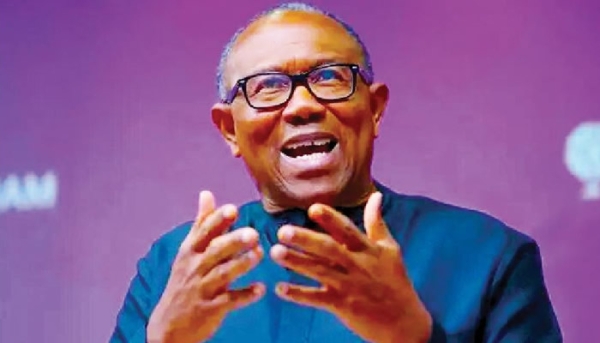
The ADC Coalition’s indecision regarding the 2027 elections further fueled disappointment, leading many to lose hope. Just as despair loomed large, a significant meeting took place in Kano last Sunday that rattled the status quo. The gathering of leading opposition figures—Peter Obi, the 2023 Labour Party candidate, and Rabiu Kwankwaso, former Governor of Kano and 2023 Presidential candidate of the NNPP—was initially viewed as a solemn religious solidarity visit. However, it transformed into a revitalising event in Nigeria’s political arena.
Peter Obi and Rabiu Kwankwaso are not just political figures; they are at the helm of Nigeria’s two most dynamic political movements—Obidient and Kwankwasiyya. The excitement ignited by this meeting resonated across the nation, sending shockwaves through the ruling party’s ranks and revealing the potential of this burgeoning alliance.
This groundbreaking Sunday meeting reignited the “romance” between the Obidient and Kwankwasiyya movements. It “shakes the table” because it signifies a possible consolidation of Nigeria’s most disruptive political forces. The prospect of this alliance is provoking considerable anxiety within the ruling APC for several strategic reasons: it paves the way for a much-needed North-South connection. In the 2023 elections, both movements faced criticism for their regional focus—Obi dominated the South and parts of the North-Central, while Kwankwaso confidently controlled Kano and the North-West. A merger, now signalled by this pivotal meeting, effectively bridges the Niger, merging the youth-led urban activism of the Obidients with the disciplined grassroots machinery of the Kwankwasiyya. They are now adhering to the African proverb that says, “If you want to go fast, go alone. If you want to go far, go together”
Political analysts assert that had these two forces united in 2023, the electoral landscape would have appeared drastically different. By 2026, amid the economic challenges gripping the nation, plus the deteriorating security situation in the country, a united opposition ticket is viewed as a “nightmare scenario” for the ruling APC. It solidifies the protest vote previously split between the Labour Party (LP) and the New Nigeria Peoples Party (NNPP). Meanwhile, the former Vice President Atiku Abubakar’s value has remained downplayed obviously despite his second position in 2023 because of the unfavourable political climate around him due to zoning. His insistence on proceeding with his ambition despite the glaring adverse arrangements is like working against the tide and has hindered coalition-building. Many political observers are even concerned about his disruptive role coming from an elder statesman. The body language in national politics today is such that any movement seeking to return power to the North in 2027 is seen as counterproductive.
In this context, the March 23, 2027, Kano meeting not only mitigated Atiku’s disruptive influence but also acted as a genuine catalyst for the opposition’s resurgence. Arguably, the “table-shaking” is intensified by the high-profile gatherings. Reports of Kwankwaso hosting Obi alongside key figures like Governor Seyi Makinde in Kano resonated throughout the political landscape because it was not mere socialising; it laid the groundwork for a potential 2027 “Mega Party” or coalition under a neutral platform like the ADC.
The resonant call of “Obi/Kwankwaso” from the jubilant Kwankwasiyya supporters has eliminated a significant hurdle related to leadership hierarchy between the two principals. By seemingly deferring to zoning, the Kwankwasiyya clearly indicated their willingness to embrace a joint ticket.
Sceptics may attempt to downplay the significance of the Kano meeting, questioning why it’s considered such a substantial event. However, the political atmosphere is charged with energy, and this alliance is shaking the table, and effectively undermining the ruling party’s dominance. The implications of this strategic partnership are impossible to ignore, heralding a new chapter in Nigerian politics.
If Obi and Kwankwaso can set aside their egos and build on the momentum from last Sunday’s courtship, they will forge a powerful electoral bloc that cuts across ethnic and religious divides—two traditional tools often exploited in Nigerian elections. An English business magnate and co-founder of Virgin Group, Richard Branson, emphasises the necessity of alliances, stating that, “they are essential to growth and provide resistance to bigger competition” and this applies in both business and politics.
Should the Peter Obi and Rabiu Kwankwaso alliance be successfully solidified, it will undoubtedly benefit the political landscape and echo Robert Jordan’s wisdom: “To fight the raven, you may make alliance with the serpent until the battle is done.”
Northern Nigeria has faced justified criticism from political analysts in this dispensation for squandering its numerical strength in pivotal political decisions. The Obi/Kwankwaso partnership represents a crucial shift, one that could enable the region to make a bold and pragmatic correction in its approach, especially in anticipation of the 2027 elections.
Nigerians facing serious challenges have every right to hold leaders accountable when they remain unresponsive. Whether leaders are merely confused or hesitant, they bear the responsibility for the repercussions of their inaction.
The geopolitical landscape of Northern Nigeria is uniquely positioned to rectify the country’s electoral failures, yet it has repeatedly missed this opportunity. The current discontent surrounding President Bola Ahmed Tinubu’s ascent underscores the dire consequences of failing to seize the moment.
A Northern-dominated national Assembly has passed three appropriations in 2024, 2025, and 2026 and seen all poorly implemented but kept mum, they passed the obnoxious tax law, the Electoral Act, sanctioned numerous loans that are unaccounted for all designed to undermine the North, and to cap it they passed the law excluding certificate falsifiers from aspiring to any position in the land. Haba! North, you have the wherewithal to avert these things but your legislators chose personal gains instead. This recurring selfishness displayed by the North especially in 2023 has thrust the nation into the prevailing political crisis. The rising support for Peter Obi, particularly in the North, may signal the beginning of the end for the political chaos that has plagued the country. God help us.

El-Rufai arrives Kaduna Court under heavy security over alleged corruption


Former Kaduna State Governor Nasir El-Rufai arrived at the Federal High Court in Kaduna under heavy security on Tuesday, March 24, 2026, as proceedings began in his corruption case.

Reports said operatives from multiple security agencies were deployed around the court, while journalists and members of the public faced tight access restrictions ahead of the hearing.

The arraignment follows confirmation by the Independent Corrupt Practices and Other Related Offences Commission (ICPC) that charges were filed on March 18, 2026. Available reports indicate that El-Rufai is facing allegations including abuse of office, fraud, conferring undue advantage, and related corruption-linked offences. Some reports also say he appeared alongside co-defendants as the trial formally opened.

The heavy security presence reflects the political sensitivity of the case. El-Rufai remains one of Nigeria’s most controversial and influential former governors, so his court appearance carries significance beyond the legal charges alone. It is being watched as a major test of anti-corruption enforcement, due process, and the willingness of institutions to prosecute politically exposed figures without fear or favour.

For now, the central questions are no longer whether he would appear, but how far the prosecution can go, what evidence will be presented, and whether this case will end in genuine accountability or become another long-running political courtroom drama. Starnews.

Iran rejects Trump’s ceasefire claim, denies talks with US

Iran on Monday rejected US President Donald Trump’s claim of a five-day ceasefire and ongoing negotiations, denying any talks with Washington and describing the move as a “retreat” under pressure.

The response from Tehran came within hours of Trump’s announcement that the United States would pause planned military strikes on Iranian energy infrastructure, citing “very good and productive” discussions between the two sides.

Iran’s Foreign Ministry категорically denied that any negotiations were underway, accusing Washington of attempting to “buy time” while regional developments unfold independently of US involvement.

Adding to the sharp rebuttal, Iranian state-linked media and voices associated with the Islamic Revolutionary Guard Corps (IRGC) asserted that no talks had taken place, claiming that the US decision to halt strikes reflected fears of retaliation rather than diplomatic progress.

Ebrahim Rezaei, spokesperson for Iran’s National Security and Foreign Policy Commission, struck a defiant tone, saying: “The battle continues… and another defeat for the devil. Trump and the United States have once again been defeated.”

The remarks underline Tehran’s attempt to frame the development as a strategic victory, portraying US restraint as the outcome of pressure rather than negotiation.

Earlier, Trump had announced a five-day pause on military strikes targeting Iranian power plants and energy infrastructure, linking the decision to ongoing diplomatic engagement. He said the move was conditional and intended to create space for a broader resolution of hostilities, adding that further steps would depend on the progress of talks.

However, the starkly conflicting narratives from Washington and Tehran have heightened uncertainty over the situation. While the US has presented the pause as a diplomatic opening, Iran has rejected the premise of negotiations altogether, signalling that mistrust between the two sides remains deep.

The divergence comes at a time when tensions in West Asia are already impacting global energy markets and supply chains. The absence of any acknowledged dialogue raises concerns over the durability of the pause and the risk of renewed escalation once the five-day period ends.

For now, the situation remains fluid, with the coming days expected to be critical in determining whether tensions ease or intensify further. Newspot.

ICPC to arraign El-Rufai Tuesday

The Independent Corrupt Practices and Other Related Offences Commission (ICPC) has announced that it will arraign former Governor Nasir El-Rufa’i in Kaduna on Tuesday.

El-Rufai has been in detention since he honoured the invitation of the Economic and Financial Crimes Commission (EFCC), on February 16, 2026.

The EFCC had grilled him for 48 hours before the ICPC moved him into its custody.

El-Rufai’s prolonged detention had sparked outrage, with many groups and individuals calling on the agency to charge him to court or release him.

In a statement on Monday, John Okor Odey, ICPC spokesman, said El-Rufai would be arraigned at a Federal High Court in Kaduna, on Tuesday.

“The suit with number FHC/KD/73/2026 has charges ranging from conversion of and possession of public property, to money laundering.

“Similarly, another charge, number KDH/KAD/ICPC/01/26, against Malam Nasir El-Rufa’i and one Amadu Sule (LEDA), has also been filed before a Kaduna State High Court in the Kaduna Judicial Division.

“The charges in the State High Court case range from abuse of office, fraud, and intent to commit fraud to conferring undue advantage, among others.

“Both charges were filed by the ICPC on the 18th of March, 2026.

“The date of arraignment in the State High Court will be communicated at the appropriate time as determined by the Court.”

The ICPC said El-Rufa’i has been duly served.

End

Obi on El Rufai: A new political temperament

Obi on El Rufai: A New Political Temperament


By Sani J. Suleiman
Peter Obi’s entry into Nigeria’s political landscape is a breath of fresh air in a system that often demonises those with differing views. His recent publicly stated advocacy for the release of Nasir El-Rufai has ignited significant discussions across Nigerian politics, especially considering their intense rivalry before and during the 2023 elections. In the traditional Nigerian political playbook, Obi could have easily reminisced about the pivotal role El-Rufai played in thwarting his aspirations Despite Obi being the people’s choice, El Rufai went for party loyalty and supported Bola Tinubu, who has now become his traducer.
However, what we are witnessing is not merely nostalgia; it is a strategic shift reflecting Obi’s commitment to a “politics of principles.” This shift serves as a foundation for a new political coalition—the African Democratic Congress (ADC)—as they gear up for the 2027 polls.
On March 9, 2026, Obi released a powerful statement on X, vehemently condemning the continued detention of El-Rufai and former Attorney General Abubakar Malami. His argument rests on three essential pillars: fairness, the illegitimacy of the government’s “Fishing Expeditions,” and the undue “repeated transfers” of El-Rufai between the EFCC, ICPC, and DSS. Obi called out this approach as a “desperate search for any charge that might stick,” challenging the integrity of the investigations. While he supports the fight against corruption, he insists that it must begin with those currently in power, emphasising that selective enforcement undermines the broader fight against corruption. He framed El-Rufai’s detention as “political persecution disguised as criminal prosecution.”
By defending a man who once dismissed him as a “tribal candidate” and a “Nollywood actor,” Obi is establishing himself as a leader who prioritises constitutional processes over personal grievances, elevating the rule of law above political grudges. As a Northerner who once admired El-Rufai until the latter joined with Tinubu in 2022, I find Obi’s principled stance on El-Rufai’s detention to be a monumental moment for our politics and for the ADC Coalition.
Both Obi and El-Rufai have recently united under the ADC banner, and Obi’s defence of El-Rufai is a savvy move to fortify this coalition. It sends a clear signal to northern power brokers that he is a fair partner, capable of putting aside past disagreements. I stand firmly with Obi’s supporters (Obidients) who interpret this act of magnanimity as evidence of his “superior temperament.” In a civilised society, detractors are entitled to fair treatment and the rule of law.
Yet, some critics may dismiss this “spirit of fairness” as merely a “marriage of convenience” with a former adversary. They are mistaken. It is high time for the North to cast aside its prejudices against Igbos and give Obi a chance. He has a proven track record that can instil confidence, especially given his pragmatic vision that has the potential to transform the North. I am happy that a formidable Northern mobilizer like Rabiu Kwankwaso is trying to identify with this Obi project. Imagine how electrifying it would be to have a political movement like the Obidient and Kwankwansiyya groups on one platform.
The time has come for the North to confront the escalating poverty in our region—a situation that is primed to erupt into crisis. We must acknowledge that no one will escape the fallout when that happens. Let’s act decisively for the collective good.
Suleiman wrote from Minna, Niger State.