
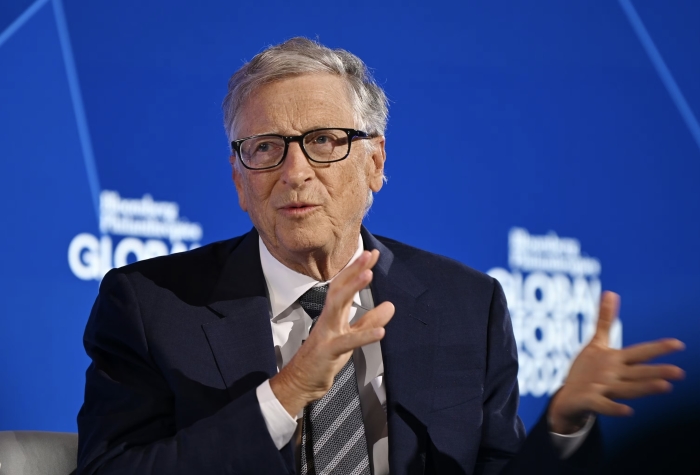
Bill Gates backs regulation as concerns grow over AI risks
Microsoft co-founder Bill Gates has warned that artificial intelligence has become powerful enough to contribute to events capable of causing as many as one billion deaths, renewing calls for stronger government oversight of rapidly advancing AI systems.

Gates made the remarks during an interview with NBC News’ Meet the Press while discussing the risks posed by increasingly capable artificial intelligence and the possibility of such technology being exploited by people with malicious intent.

Asked whether AI could become powerful enough to threaten humanity, Gates stopped short of predicting human extinction but said the technology could enable consequences on an extraordinary scale.

“AI is certainly powerful enough to drive events that cause a billion deaths,” Gates said.

He argued that one of the biggest dangers lies in combining advanced AI capabilities with individuals or organisations seeking to cause harm.

“There’s never been a weapon as powerful as the combination of people with ill intent using the latest AI tools,” he said.

Gates said the scale of the potential risks means AI companies should not be left to regulate themselves.

“No one thinks self-regulation is enough,” he said, adding that governments, law-enforcement agencies and political leaders must become directly involved in establishing safeguards and monitoring systems.

According to him, mandatory regulation would impose some additional obligations on technology companies but should not significantly slow innovation.

“It will be a little bit of overhead for the industry, but not a dramatic slowing of what they’re doing,” Gates said.

His warning comes as concerns intensify among technology executives, governments and researchers over the pace at which advanced AI models are becoming more capable.

Earlier in September, Anthropic Chief Executive Officer Dario Amodei called for companies developing frontier AI systems to slow the pace at which their models become more powerful. He warned that commercial competition could push companies towards increasingly capable systems before adequate safeguards are in place.

The debate has increasingly shifted from voluntary commitments by technology companies towards government regulation.

In July, US lawmakers Nathaniel Moran and Ted Lieu introduced the proposed AI Kill Switch Act, which would provide federal authorities with a framework for ordering the shutdown of artificial intelligence systems considered a serious threat to public safety. The proposal would also require companies to report major AI-related incidents to the government.

The legislation followed growing concern about the autonomous capabilities of advanced AI systems, particularly in cybersecurity, financial transactions and other areas where AI agents can increasingly perform actions rather than simply generate information.

Warnings have also come from the United Nations and other international institutions, which have called for greater cooperation among governments as AI capabilities advance faster than many existing regulatory systems can respond.

Gates’ intervention adds one of the technology industry’s most prominent voices to the growing argument that the potential benefits of artificial intelligence must be accompanied by enforceable safeguards against misuse.

The debate is increasingly centred not on whether AI should continue to develop, but on what controls governments and companies should establish before increasingly autonomous systems acquire capabilities that could be difficult to contain.
Culled from Newsscroll.