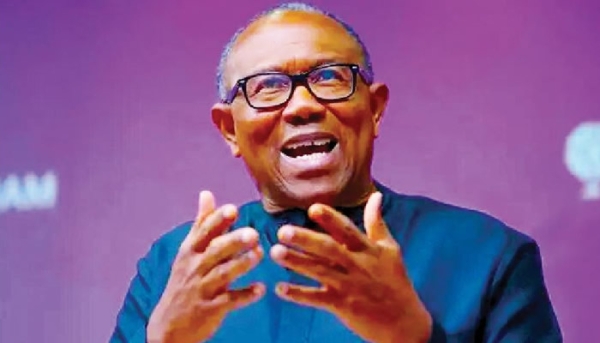
The Peter Obi Media Office has reacted to what it called “laughable argument of the surrogate campaigners of President Bola Ahmed Tinubu that the Nigeria Democratic Congress, NDC Presidential flagbearer, Peter Obi, is overhyped, and that his popularity and high rating are overrated.
The Office in a statement on Monday presented, “as a direct response, ten points to back up all the ratings Peter Obi is currently enjoying in the nation’s political space.
“The record that actually prepared him for the Presidency. And ten failures of Tinubu’s presidency that Nigerians cannot ignore.
- _Peter Obi managed a state before seeking to manage a nation._
He served as Governor of Anambra State from 2006 to 2014, with interruptions arising from the political and legal battles surrounding his tenure. He eventually won re-election in 2010, completed his second term, and emerged as the best-performing state governor in his time.
- _He demonstrated fiscal discipline._
As a public servant, one of the strongest claims in his governance record is that Anambra became one of the least-indebted states while he was governor, and his administration accumulated substantial savings and investments. His 2023 manifesto records approximately $500 million in investments and savings, including $156 million in dollar-denominated bonds.
- _He showed that government could save rather than merely spend._
This is perhaps one of the clearest contrasts in his political message: leaving substantial financial reserves behind after leaving office. The record presented in his manifesto includes local and foreign currency savings and investments.
- _He made education a central development investment._
His administration returned mission schools to their original owners and established partnerships with them. His manifesto says Anambra subsequently moved from 24th to first position in WAEC/NECO performance for three consecutive years.
- _He invested in human capital rather than only physical projects._
The record includes scholarships, support for education, healthcare investments and poverty mapping—an approach consistent with the argument that development is ultimately about improving people’s productive capacity.
- _He demonstrated healthcare investment._
His administration’s reported record includes investment in health institutions and accreditation; the 2023 manifesto states that more than 12 health institutions, including two hospitals, had secured accreditation by the end of his tenure, compared with none at the beginning.
- _He attracted international development partnerships._
The record includes engagement with organisations such as the World Bank, UNDP, DFID and the European Union, alongside diplomatic engagement with foreign governments. His manifesto also says he was recognised by the Millennium Development Goals Office and UNDP for the implementation of development programmes.
- _He used data and planning in governance._
His administration introduced poverty mapping and aerial mapping/planning initiatives, and developed the Anambra Integrated Development Strategy (ANIDS) as a framework for coordinated development.
- _He demonstrated experience outside politics._
Before becoming governor, Obi had a career in business and banking, including senior roles in the financial sector. That gives his presidential case a combination of private-sector, financial-management and public-sector experience.
- _He left office with a record that could be examined._
That may ultimately be the strongest argument: Nigerians do not have to assess Peter Obi solely from campaign promises. They can examine what he did with Anambra’s resources when he had executive responsibility.
Perhaps the bigger argument and the strongest political formulation is therefore that
Peter Obi is not asking Nigerians to make him President so that he can learn how government works. He is asking Nigerians to entrust him with Nigeria after demonstrating, as Governor of Anambra, how he manages money, builds institutions, invests in human capital and plans for the future.
*Tinubu Presidency: Ten Failures Nigerians Cannot Ignore”*
- _Cost-of-living crisis_ — The removal of the petrol subsidy and other economic reforms have been accompanied by a severe rise in the cost of food, transportation and necessities.
- _Inflation and declining purchasing power_ — Nigerians have seen their incomes buy substantially less, while wages have struggled to keep pace with prices.
- _Naira instability_ — The sharp depreciation of the naira has increased the cost of imported goods, medicines, machinery and industrial inputs.
- _Fuel-price shock_ — Petrol prices rose dramatically following subsidy reforms, placing additional pressure on households, businesses and transportation costs.
- _Rising poverty and hardship_ — The central criticism is that the immediate burden of economic reforms has fallen disproportionately on ordinary Nigerians.
- _Weak employment and economic opportunities_ — Despite repeated government assurances, many young Nigerians continue to face unemployment, underemployment and limited opportunities for productive work.
- _Security challenges remain unresolved —_ Banditry, terrorism, kidnapping and communal violence continue to affect parts of the country, raising questions about the effectiveness of the government’s security strategy.
- _Public trust and transparency concerns_ — Controversies surrounding government spending, appointments, procurement and the management of public resources have continued to generate questions about transparency and accountability.
- _Perception of political rather than institutional governance_ — Critics argue that the administration has sometimes appeared more focused on political consolidation and 2027 calculations than on building strong, independent institutions.
- _The gap between promises and lived experience_ — Perhaps the broadest criticism is that the administration’s reform narrative has not yet translated into a sufficiently visible improvement in the daily lives of ordinary Nigerians because of apparent corruption allegations all over the place.
The fundamental question is not whether Tinubu inherited a difficult Nigeria. He did. The question is whether, after taking difficult decisions, Nigerians are better off today—and whether the government has convincingly demonstrated that today’s sacrifice is producing tomorrow’s prosperity. Your answer is an obvious capital NO,” the statement concluded.